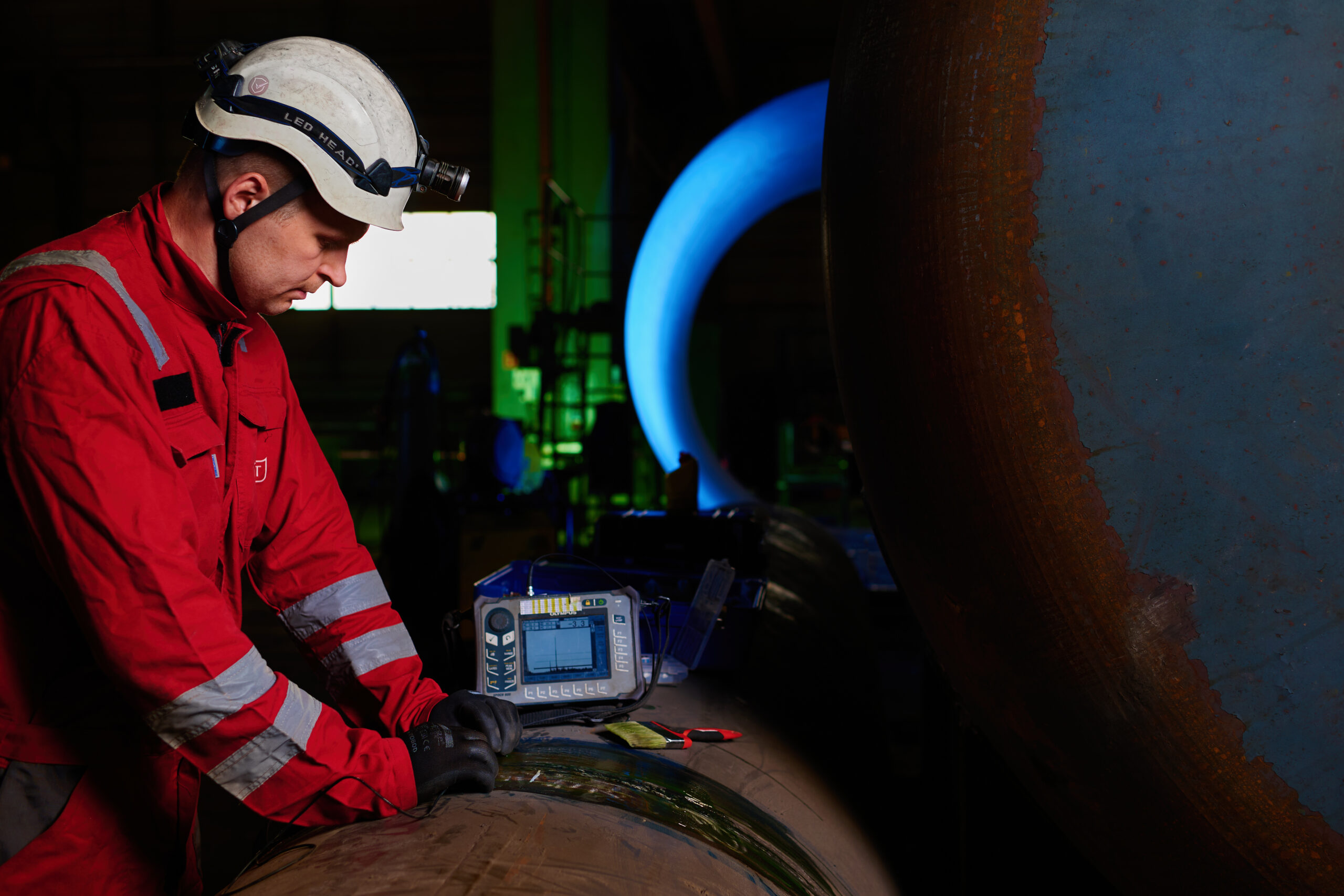
MT 1+2 | Qualification Training + Qualification Exam
Training and qualification exam
The training is conducted in-person and lasts for 5 days – from Monday to Friday.
The course includes a theoretical part, during which participants will learn, among other things, the physical principles of the MT method related to electricity and magnetism, the types and properties of various magnetic fields, methods of magnetization, and the concept of indication from discontinuities, the inspection and measuring equipment used, testing techniques, detection materials, and reference standards used. Furthermore, participants will become acquainted with the requirements of various standards, which dictate not only the environmental conditions for carrying out MT inspections, such as minimum illumination or UV radiation levels, but also the minimum and maximum magnetic field strength in the tested object, and requirements for inspection personnel, such as near vision acuity and color differentiation. Participants will also learn about the significant limitations of the MT method, including its applicability only to ferromagnetic materials.
As part of the practical classes, a full MT examination of actual samples from different manufacturing sectors is conducted, starting each time with checking environmental conditions, through examination and assessment of the obtained results based on adopted criteria, and ending with completing the test report. During the practical classes, various methods of magnetizing the object are used (yoke electromagnet, rigid coil, direct current flow, and multi-directional magnetization using a magnetic bench). Participants will learn two detection techniques (colored and fluorescent). An indispensable element of the practical classes is also drafting test instructions for various objects (welded joint, casting, forging, etc.). Considering OHS aspects, during the classes, the use of harmful substances is minimized – aerosol solvents are not used – trainees learn controlled and correct use of these substances, which protects the respiratory tract and shapes proper work habits. The training is conducted on fully equipped testing stations, including exhaust systems and professional lighting, including UV LED lamps for the fluorescent technique.
During the training, participants will solve and discuss sample test questions to reinforce the knowledge they have already acquired. They will also become familiar with the relevant provisions of the Pressure Equipment Directive 2014/68/EU regarding the approval and recognition of NDT personnel in this area.
The appropriate combination of all the above elements allows for easy and effective absorption of the required knowledge, direct translation of theory into practice, and proper preparation for a possible exam and further work in the profession.
The sixth day – Saturday – is the day of the qualification exam, which consists of a theoretical and a practical part. The exam is conducted by the accredited certification body TÜV SÜD Polska. Passing the exam qualifies one to apply for the MT 2 competence certificate, confirming the acquisition of relevant qualifications for performing magnetic particle testing, valid for 5 years. After this period, the certificate must be renewed.
The training and qualification examination are conducted in accordance with the requirements of the PN-EN ISO 9712 standard, which defines the principles for the qualification and certification of non-destructive testing personnel. The obtained certificate is recognized in the domestic and European markets.
What is included in the price ?
The training fee includes:
1. Participation in training
2. Training materials and literature
3. Availability of required measuring and control equipment
4. All-day coffee service
5. Dinner
6. Certificate of participation in training
What does the exam look like?
The qualification exam consists of verifying the theoretical knowledge and practical skills of the Candidate in the field of a given NDT method. It consists of three independent parts:
Part 1 – General Examination (written)
General knowledge test on a given NDT method. It consists of a minimum of 40 multiple-choice questions, each with at least four possible answers. The time limit is a maximum of 2 minutes per question. Candidates are not allowed to use any aids in this section.
Part 2 - Specialist Exam (written)
Specialized knowledge test regarding sectors covered by certification. It consists of a minimum of 30 multiple-choice questions. The time limit for answering is a maximum of 3 minutes per question. In this part, the Candidate may use the provided regulations, standards, and specifications.
Part 3 – Practical Exam
It consists of a written and a practical part. The candidate randomly draws a set of 3 examination samples and conducts their examination along with record-keeping according to the guidelines provided by the examiner. The candidate independently selects the examination technique, determines the examination conditions, and develops a written examination instruction for one of the drawn samples. The time for examining the samples and developing the instruction depends on their level of complexity and difficulty and is determined each time by the examiner. In this part, the candidate may use provided regulations, standards, and specifications.
To pass the entire exam, you must score at least 70% on each of the three sections.
The qualification exam result is valid for 2 years. During this time, the candidate should submit an application for certification to TÜV SÜD Polska. If the application is not submitted within the specified period, the exam results will expire, and the candidate will be required to retake the exam.
The exam questions and sets are developed and updated by TÜV SÜD Poland and remain confidential until the exam date. The exam samples are different from the training samples.
Who is this training for?
The MT 1+2 training is intended for individuals whose professional responsibilities include quality assessment, technical safety, and the conformity of products and structural components with standards and regulations, particularly in the detection of surface and near-surface discontinuities in ferromagnetic materials.
Due to the use of strong magnetic fields, individuals with implanted pacemakers, cardioverter-defibrillators, or neurostimulators cannot participate in the training.
The training is intended especially for:
- individuals preparing for MT 2 certification according to PN-EN ISO 9712.
- NDT inspectors and candidates for NDT inspector positions,
- quality control (QA / QC) personnel,
- production and maintenance engineers,
- managers and foremen,
- technologists and welders,
- employees of construction, assembly, and service companies.
Benefits for the participant:
- Thorough preparation for the MT 2 qualification exam,
- acquiring relevant practical skills that can be immediately applied to work,
- possibility of obtaining the MT 2 competence certificate issued by TÜV SÜD Poland,
- the possibility of performing magnetic tests independently in industry,
- increase professional competencies and value in the job market,
- Obtaining a research alternative to penetrant testing (PT) for ferromagnetic materials – the possibility of faster testing (results immediately after object magnetization) and less restrictive surface preparation requirements (discontinuities do not need to be open to the surface).
How to buy training?
The training can be purchased in two ways.
Online purchase:
1. Add the training to your cart and fill in the participant's details.
2. Confirm required consents and statements, and pay for your order.
3. After manual verification of the order and correctness of the data, the completed documentation for signature will be sent to the indicated e-mail address – it will be filled out by the payer, the training participant, and the person confirming the completion of the professional practice.
Offline purchase:
Detailed information regarding purchases made without the website can be found in the Documents tab.
Why choose Navi Academy?
Consultations with trainers
Training participants have the opportunity to consult with trainers both during and after the training.
As part of the training, there is an opportunity to analyze real problems from the participants' workplaces, and the trainers flexibly adjust the session time to discuss these practical cases.
If a participant requires technical support after the training, the trainer can provide a free phone consultation.
Coaches with many years of training experience
The training courses are conducted by trainers with many years of experience in implementing and organizing NDT training. The trainers come from various manufacturing and processing industries, such as the metallurgical, shipbuilding, construction, energy, and petrochemical industries. They combine practical knowledge gained from implementing various projects in real industrial conditions with appropriate didactic preparation and a well-thought-out teaching strategy, which allows for the transfer of knowledge in an accessible and understandable way and effective preparation for exams and professional work.
Hands-on industrial experience
Our training courses are based on experience gained in real industrial projects. Navi Academy's substantive background is built on over 30 years of experience at Navitest and the work of over 100 inspectors performing NDT on various industries in European markets.
Benefits:
- knowledge based on real industrial projects,
- knowledge of various technologies and products,
- preparation for work in an international environment,
- discussing unusual and problematic cases,
- a practical approach aligned with current market requirements.
MT Training Program
- History and Development of the MT Method.
- Physical principles used in the method.
- Research techniques and types.
- Applied control and measuring equipment and required supervision.
- Knowledge of the objects of study.
- Standards for examined objects and research methodologies.
- Schema, stages, and conditions of the study.
- Evaluation of indications according to the given criteria.
- Logging test results.
- Editing test instructions.
- Qualification and certification of personnel according to PN-EN ISO 9712:2022.
- Health and Safety Issues.
Scope of Competencies – MT Levels
MT Level 1
Level 1 Inspector has the ability to perform magnetic testing according to the current test procedure. They can use measuring equipment to determine environmental parameters (light meter, thermometer), assess the current surface condition, and prepare the object for testing, conduct the test and evaluate readings, and record and interpret the results within the scope defined by the test procedure.
MT Level 2
A Level 2 Inspector has expanded competencies that additionally include developing magnetic particle testing instructions for Level 1, selecting testing techniques, magnetization parameters, and detection media, independently performing complete MT tests with final evaluation of indications, and preparing test protocols and reports. They are also authorized to supervise the work of Level 1 qualified personnel.
Training Norms
- PN-EN ISO 12707
- PN-EN ISO 9934-1
- PN-EN ISO 9934-2
- PN-EN ISO 9934-3
- PN-EN ISO 3059
- PN-EN ISO 17635
- PN-EN ISO 17638
- PN-EN ISO 23278
- PN-EN 10228-1
- PN-EN 1369
- PN-EN ISO 10893-3
- PN-EN ISO 10893-5
- EN 13445-5
- EN 13480-5
- PN-EN 12952-6
Sectoral scope according to PN-EN ISO 9712:2022
The training covers the following sectors:
Industrial sectors
- pre- and in-service inspections (s),
- production.
Product sectors:
- castings,
- forgings,
- welded connections (w),
- pipes of various diameters (t),
- Plastically worked products (WP).
Additionally, the training covers the area of the Pressure Equipment Directive 2014/68/EU and personnel qualification for performing NDT of non-detachable joints on pressure equipment of categories III and IV – PED sector: w.
Upon successful completion of the training, the participant receives a certificate of participation, which qualifies them to take the qualification exam and subsequently obtain the MT2 competence certificate.
Prerequisites
- No medical contraindications to performing magnetic resonance imaging.,
- Due to the presence of strong magnetic fields, individuals with implanted pacemakers, cardioverter-defibrillators, or neurostimulators cannot participate in the training.,
- Eye examination – possession of a medical certificate confirming compliance with vision requirements according to item 7.4 of standard PN-EN ISO 9712:2022.,
- Practical internship – Documented, preliminary practical internship qualifying for admission to the certification examination according to PN-EN ISO 9712:2022 and the requirements of the Personnel Certification Body.,
- Minimum vocational education with a technical profile,
- Basic technical knowledge in the field of component construction and manufacturing processes.,
- The ability to perform basic mathematical calculations,
- Technical drawing comprehension,
- Having a scientific calculator and knowing how to use it.
To participate in the training, you need to provide:
- training participation form,
- current certificate of vision,
- Payment confirmation.
To take the exam, you must provide:
- application form for the qualification exam,
- Application for non-destructive testing personnel certification along with an agreement,
- current certificate of vision,
- Certificate of Education,
- certificate of successful completion of training,
- Payment confirmation.
Downloadable documents:
- Training Participation Application Form NA,
- Application for personnel certification along with the agreement,
- Application for an examination,
- Certificate of Vision Capability Template.
Formal procedure
Scans of completed documents and required attachments should be uploaded to your user profile on www.naviacademy.com.pl or sent to the email address: academy@naviacademy.com.pl.
The required payment must be made. A prerequisite for participating in the training is submitting the application form (or a scan thereof), a current vision certificate, and making the full payment.
The fee for participation in the training should be paid via the website or to the bank account:
NAVI ACADEMY LLC.
ING Bank Śląski S.A.
Account number: 60 1050 1764 1000 0090 8426 6643
Payment title: participant's first and last name.
Applications submitted without full payment will not be considered.
After verifying the provided documents (user profile / email), the reporter receives feedback on their acceptance or any deficiencies.
Scans of properly completed documents must be submitted no later than 14 days before the start of the training.
Original documents must be submitted no later than the first day of training.
Withdrawal from participation
Withdrawal from the training can be done via the website (user profile) or in writing at least 10 calendar days before the training start date. In case of later withdrawal, there is no right to a refund of the training fee paid.
What is magnetic particle testing (MT)?
Magnetic particle testing (MT) is an extension and complement to visual inspection, primarily for detecting surface discontinuities and, to some extent, those located shallowly beneath the material's surface. The method utilizes the ferromagnetic properties of the material being tested, which is also its primary limitation. By creating a directional magnetic field of appropriate intensity and using specialized ferromagnetic detection powders, it is possible to quickly and precisely locate material discontinuities such as cracks, laps, folds, rolled-in scale, or lack of fusion. The detection powder creates a visually discernible indication on the surface of the material being tested, indicating the presence of a material discontinuity at that location.
The MT method allows for the test result to be obtained immediately after the application of the detection agent, without the need for any additional waiting time. The resulting indication is then further evaluated based on the acceptance criteria applicable in each case. Depending on individual needs and test execution conditions, the MT method can be carried out using the color contrast technique with white light inspection, or the fluorescent technique, which requires inspection under ultraviolet light.
Magnetic testing is characterized by high sensitivity and reliability, making it widely used in many industrial sectors, such as construction, energy, petrochemicals, metallurgy, automotive, and aviation. Depending on the type of object and the scope of the examination, it requires the use of appropriate magnetic field exciters, such as yoke electromagnets, current generators, or rigid coils. Unlike the penetrant testing method, MT testing does not require such thorough degreasing of the surface under examination and can also be used to test painted components.
Benefits of the MT method
- detecting very small surface discontinuities,
- the possibility of detecting subsurface discontinuities,
- precise location of discontinuity,
- immediate test result,
- the possibility of examining elements coated with paint or galvanic coating,
- Lower surface preparation requirements than PT.
Application of the MT method – industries
The MT training is aimed at specialists working in industries where the detection of surface and subsurface discontinuities in ferromagnetic materials is required, at every stage of production and operation.
Typical application areas include:
- metallurgical industry,
- construction industry,
- Industrial construction,
- energy industry,
- petrochemical industry,
- shipbuilding industry and offshore infrastructure,
- railway engineering,
- automotive,
- aviation,
- army,
- critical and public infrastructure,
- service research laboratories.
Method limitations
Magnetic particle testing (MT), despite its high sensitivity and effectiveness in detecting surface and near-surface discontinuities, has certain limitations due to the physics of the method itself:
- the method may only be applied to ferromagnetic materials (e.g., carbon and low-alloy steels),
- is not suitable for testing non-magnetic materials such as aluminum, copper, austenitic stainless steels, or plastics,
- The detectability is limited to surface and shallow subsurface discontinuities,
- The effectiveness of the examination depends on the correct selection of the direction and intensity of the magnetic field.,
- Thick paint or protective coatings may reduce the legibility of indications.
Despite the limitations mentioned above, the MT method remains one of the most effective NDT methods for inspecting steel components, especially in the areas of welds, forgings, and castings.
Training cost
Choose the type and date of the training
- Training duration: 5 days (45h) + 1 day exam
- Training format: on-site 80-299 Gdansk, ul. Astronomów 5
- Standard / norm: PN-EN ISO 9712:2022/2014/68/EU sector „PED: w”
- Training Levels: 1+2
- Food: included (lunch + catering)